First Holy Communion
The Challenge

“Go take some pictures of your sister,” my mother said, handing Linda the small camera to capture my First Holy Communion Day.
The two of us spilled laughing into the May afternoon as I sprang into cartwheels over our scrappy lawn. The perfect shot was placing hands on my hips and falling into a perfect split, veil askew.
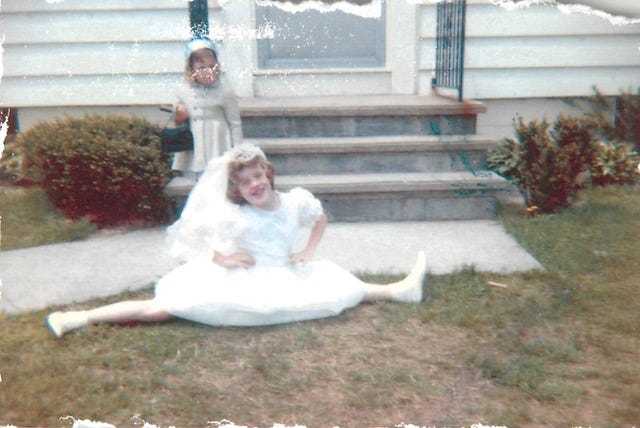
Mrs. Dietz, who lived a few doors down, reminded me as I grew of looking out her window that day and seeing me rip down Morton Rd, white patent leather shoes pumping the petals of my rusty green bike with my veil trailing as the neighborhood dogs barked.
Even those of us who drift far from religion often remember that day. First Holy Communion marks what the Catholic Church calls the age of reason — the moment a sacred seed of awareness is believed to awaken in a child.
It was George who brought it up when young George reached the age for his First Communion.
“I don’t feel comfortable not giving him some kind of spiritual foundation,” he said. “Something he might need someday. It feels like neglect.”
A lot happened between the click of that shutter on my communion day and when George announced his desire to bring our son into the fold. By then, church had all but disappeared from our lives, reduced to funerals, weddings, and memories we rarely touched.
In Japan, among mountaintop and lakeside shrines, not even the pine incense curling around curved wood was strong enough to touch my roots.
In China, I walked through the halls of the once sacred Shaolin Temple and felt no connection as monks asked for money.
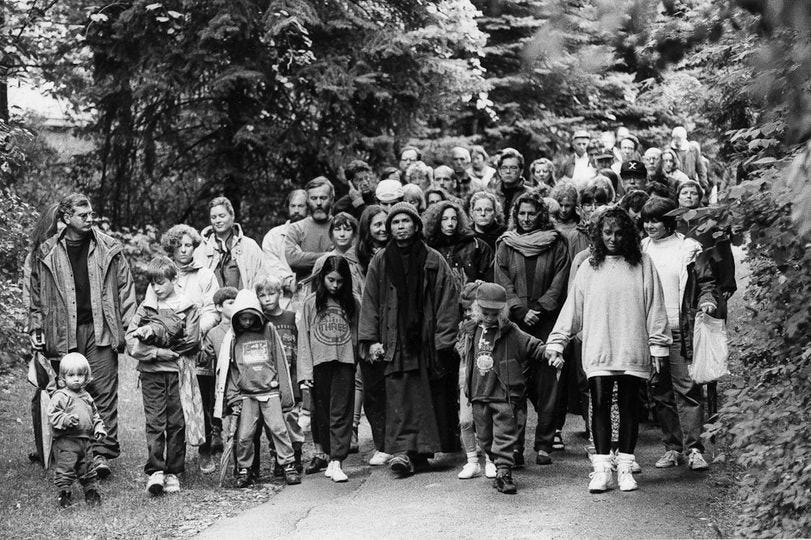
Thích Nhất Hạnh’s words were the first ones to gently tap my spirit. George, young George, and I attended a five-day retreat with him where we walked beside him in meditation. During one of his dharma talks, he said something unexpected: that the path toward inner peace is often not an escape from our roots, but a return to them.
I knew from therapy how scorching it could feel to warm the cold roots that ultimately held the nourishment needed to become whole.
“I will teach him,” I said, surprising even myself with no idea where this might lead.
Mrs. Latanzi, the director of Religious Education at the Catholic Church in our small town, assigned me eight children to teach in my home along with a study guide.
The truth was, I had issues with the Church.
The words “God the Father” alone were enough to tighten something inside me.
The image of God had fused with that of my own father: a World War II veteran with a hair-trigger temper who could erupt over something as small as a bubble popped unexpectedly from a piece of chewing gum. There had never been much room for discussion after the outrage or a quick slap across the back of the head.
When I heard “God the Father,” I imagined a God watching closely for mistakes, ready to punish them instantly. A God who could punish even the innocent joy of a young girl popping bubble gum.
Preparing for the first lesson, I realized how little I knew myself. Catholics, after all, had a reputation for not reading the Bible, and I was no exception.
The first lesson described the details of the first Passover. It startled me with its drama. Blood on doorways. Fear. Protection. Families hurriedly preparing a meal with meticulous instruction before fleeing oppression into the unknown. I decided to cook and share that meal they described with the children for our first lesson.
We ate lamb and tasted the bitter herbs together as we talked about that dramatic night.
I was hungry to learn more.
I started attending morning Mass in the small church on the town Green surrounded by white steeples and old trees. An older woman asked if I would become a lector.
I said yes.
At night I studied the readings carefully before standing at the pulpit the next morning to read them aloud. When someone failed to arrive, I quietly stepped in. Slowly, scripture became a reflection on how to live my life. A fresh way to look honestly at suffering, forgiveness, humility, and love.
Meanwhile, the lessons with the children continued. As I taught them, I learned as if for the first time. Teaching my son was a welcome journey. Not an instant transformation, but a slow and steady rewiring of antiquated patterns as, week by week, I began touching parts of the tradition I had never truly known.
One lesson told the story of Rebekah offering water to the servant of Abraham as he searched for a wife for Isaac. Her hospitality and willingness to serve changed the course of her life.
Something about that story stayed with me. I began inviting neighbors for dinner, opening our home on holidays, creating the kind of table I had once been searching for myself.
My favorite Mass became Holy Thursday, three nights before Easter. The first reading returns to the telling of that first Passover meal, and the last reading is of the Last Supper. Jesus gathers with his disciples before his death to teach them how to live. Every year on that night, churches around the world perform the ritual of the washing of the feet. We watch the priests kneel before twelve people and wash their feet one by one.
The message is simple and radical: if you want to follow this path, you serve others.
For me, that became the center of what faith was about. The roots I had neglected were still alive beneath the surface, unfurling tendrils into rich soil.
God was not the father I grew up fearing.
This mystery was far bigger than anything I had previously understood. What I found there was not punishment or perfection, but rather an encouraging and forgiving presence.
In the place of fear were service, humility, and love as they were meant to be.
Somewhere along the way, the young girl inside me began doing cartwheels again.
Great photo—and story. I worked out a lot of Dad issues with my pastor when I returned to the faith. It took a while to understand that while I can push people away when I’m afraid they’ll hurt me, God is stronger than any of them—or me.