The Standing Meditation
An Explosion of Stillness

On the last day of our retreat, I stood barefoot in the grass, the warm blades brushing against my feet at the community center in town about a mile from our place. The sun pressed into my arms, the temperature already over 90 degrees.
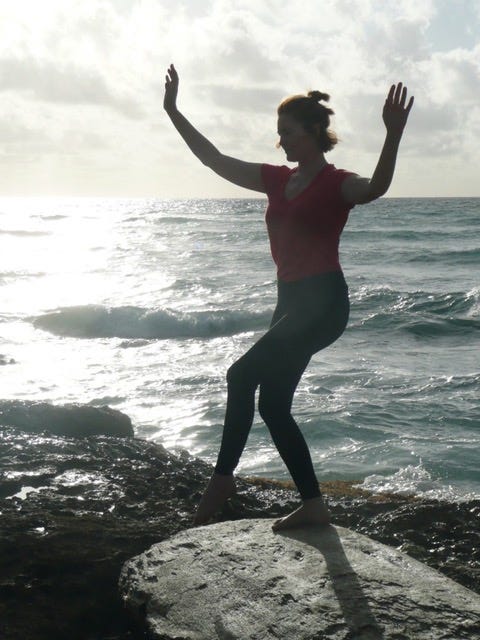
We were about to begin the standing meditation: to stand in stillness, eyes closed, knees slightly bent, hands relaxed at the sides, breathing into the lower abdomen. In this quiet, the circulation that had been set in motion by the previous exercises could continue in a new way. What had been stirred by the twisting, squatting, and pushing of palms could move into the joints, muscles and fascia where disease might be hiding. The body could begin to clear what it had been holding.
Sometimes spontaneous movements would arise, but that day I stood completely still.
After a few moments, my body temperature began to drop. The cold grew in my torso and spread outward, into my limbs, then my head. It was not a chill that could be warmed away. It felt feverishly cold, the kind that makes your joints ache and your head throb.
I opened my eyes before the full twenty minutes had passed.
The sunlight was too bright. I could only make out the silhouettes of the others standing in the field. My vision blurred. My mind began to spin, thoughts looping, searching for something to hold onto.
Images surfaced without warning. Scenes and symbols from the religion of my childhood, long forgotten, rising as if they had been waiting. A crimson heart wrapped in thorns, Mary’s pale blue dress soaked with tears.
I stayed with it. Breathing calmly. Letting it pass, as we were told.
The twenty long minutes of meditation ended. Jack, a young attorney from the Upper East Side I got to know, came over to chat. The cold that began in my chest moved up and out opening my throat to sobbing then tears. “Emotional releases” made surprise appearances for a number of students the past few days. We learned to let them be. By the time we drove back to our place I was grateful my temperature had returned to normal after the tears. My sharp vision returned.
By the time I spread my chunky peanut butter on bread at lunch with a few others, we laughed at the bizarre occurrences; the range of emotions we had witnessed, the heightened sense of smell, the strangeness of it all.
I arrived home after dark. I wanted to know the diagnosis for the lump in Linda’s breast.
I could see my father through the screen door as I walked up the sidewalk.
“How is Linda?” I asked, the screen door not yet closed behind me.
He lifted his arm and gave a thumbs down.
It was cancer.
I called Judy, the middle-aged philanthropist who was hosting our teacher on his first teaching visit from China.
“My sister has cancer,” I told her, and asked if it would be possible to meet Master Zhao for a short visit. He was staying on for another ten days to teach a beginner class.
We piled our families into two cars and drove to Rhinebeck. The kids got bologna and ham-and-cheese sandwiches at the general store and brought them back to Judy’s to sit by the pool while Linda and I were brought into a room in the main house.
We had both read Encounters with Qi, the account of a Harvard-trained Western medical doctor’s experience with Chinese medicine. In it, he describes meeting our teacher, Zhao Jin Xiang, one of the most well-known qigong masters in China.
Linda and I sat waiting until the translator and Zhao entered. He drank a full glass of orange juice, then sat down, as calm as he had been the whole time, his oversized, tanned hands resting on his knees. He had a large girth and a round, shiny face, his black hair parted on the side and held in place with something thick. He smiled and listened as the translator spoke.
“What is your sister feeling, Maureen?” he asked, pronouncing my name Mao oo en, the middle syllable low and rounded. I had gotten used to the sing-song way he said my name with his gentle voice. Despite his size, a good six feet, his tone was soothing, making anything unexpected feel natural.
“She’s afraid,” I said.
He directed Linda to close her eyes. Then he lifted his arm, hooking his thumb to his ring and little finger, extending his index and middle fingers like a blade. We called this “sword fingers” and used it in our exercises to focus energy, directing it through the two fingers. He pointed them toward her chest for about ten seconds, dropped his arm, and told her to open her eyes.
“What did you feel?”
Linda was cluthing her chest. “Burning.”
“Mao oo en,” Zhao looked in my direction. “Teach her what you learned.”
The next week, our families left for a vacation on Martha’s Vineyard. I taught Linda the five routines on the lawn of our cottage as the kids laughed and imitated us. We laughed too, eating dinners together after days swimming in cold coves and getting double-scoop ice cream cones in town.
Linda went on to have the prescribed mastectomy, radiation, and chemotherapy. She learned qigong quickly and we practiced it together for the year.
As August neared its end, I was the one who suggested to George that we consider enrolling young George in kindergarten in the country.
Thank you Maureen for sharing your personal experience with qigong. It clearly shows the internal power that qigong has over one’s body.
It was only after studying qigong that it became a huge part of my journey with cancer. I no longer felt as only an observer of my disease; but rather, I became a participant in the healing of it. As I did the simple qigong routines in my hospital room, my doctors became very curious. That was 38 years ago.
Today, thank goodness, times have changed. Eastern and Western medicine work together for the betterment of patients. Whether you are dealing with a serious issue, or you just want to feel in optimal health, I highly recommend learning about qigong. It will be a game changer in your life.