When the Body Speaks
A New Way of Seeing

For more than a year, the wheezing in my lungs woke me at 3:00 a.m.
Each night it came the same way. A tightening that would not release. I would fall back asleep. By morning, it was gone, as if my body had taken hold of something in the dark and let it go again with the light.
And then one July evening, without warning, my chest loosened and the contractions stopped. Completely.
The change began months earlier, though I did not know it then.
In mid-December, George, young George, who was four, and I returned from the West Coast. We climbed to Inspiration Point in Yosemite. I remember the height of it, the way the valley opened without warning, as if the world could shift in a single moment if only you were placed high enough to see the whole sweep of it.
When we came home, a catalogue sat in the small pile of mail that had gathered in our absence. The New York Open Center. I flipped through it without much intention until one listing held me. Qigong. I did not know how to pronounce it. Only that it promised health through slow, deliberate movement.
I signed up.
The class met twice a week in the evening. We sat on a wooden floor, a circle of strangers, each of us, it seemed, looking for some ease in our hectic young lives. The teacher spoke in Chinese. Her words came to us through a younger translator. On the board behind her was a drawing of the spine marked with three pathways we were told were meridians.
We were given names. Baihui. Laogong. Yongquan. The sounds were unfamiliar and made a few of us smirk. What was this anyway? They called it Soaring Crane, a type of ancient exercise that helped balance what was called qi, or vital life energy.
I wanted to learn the movements. They came easily to me, but the mental focus did not. Soaring Crane Qigong demanded a kind of attention that was challenging to give.
We were taught to move the mind through the body, to rest attention in one place, then another, as deliberately as the body moved. I had been trained in speed, in rhythm, in the discipline of dance. I was a fashion photographer. I liked results I could see by the next day. I was a young mother in Manhattan with playdates to coordinate and bedtime to do together.
This practice began to push me out of my comfort zone into a more attentive, less hurried pace.
After the fourth week of class, three of us went out for a beer.
“I heard qigong is good for sex,” Cathy said, and we laughed, as people do when they are not yet sure what they have stepped into.
A couple of weeks later, she told us she had begun coughing up black mucus from her lungs. She thought it might be from the exercises. She was trying to quit smoking.
My limited view on health and healing had already begun to open, though I did not trust myself to say it out loud.
About a month into the class, we were invited to a ten-day retreat in upstate New York. The originator of the form would be there. We all agreed to go.
By July, I wanted to spend the time with my family. The days were longer and we spent more time in Connecticut than New York. George was working with Bob in Litchfield, helping to clear the land to build homes. Life had softened into something easier. Young George painted space shuttles and flowers on an easel that stood beneath the sugar maple tree outside our back door. My sister visited often with her children. We swam, cooked outdoors, and let the days unfold without demand.
I missed the first night of the retreat.
Michael, a young man from our class back in the winter, called.
“Are you coming? You really should see this guy. He’s wearing lavender silk tai chi pants and a matching shirt.”
His amusement and uncertainty stirred my curiosity.
George helped me pack the Jeep the next morning, and I left with a mixture of reluctance and attraction. I made the two-and-a-half-hour drive to Rhinebeck, arriving just as the others were breaking for lunch.
The days took on a rhythm that soothed me. Mornings, we practiced in the open air with the scent of honeysuckle drifting through the heat. Afternoons were for lectures, mostly about how qigong was based on Chinese Medicine. We ate simply, hungry after long hours of movement and instruction.
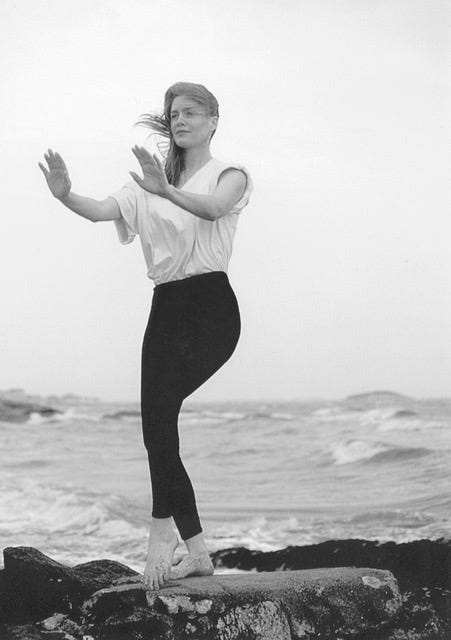
Five days into the retreat, the wheezing that had pulled me awake night after night for more than a year vanished. The tightness in my chest did not get better gradually. It just stopped.
Instead of a sense of relief, something closer to unease arrived. How could that have happened? Could these meditative movements really work?
The teacher was not surprised. “But how does that work?” I asked.
“You do not need to know how qigong works in order to feel the effects,” he said. “If you really want to know the theories behind it, you need to study Chinese medicine, and that takes a long time.”
The frame of reference I had relied on to understand my body crumbled. And then, a day later, came the phone call from Linda. She had discovered a lump in her breast. Vulnerability filled me.